Concrete Mixers
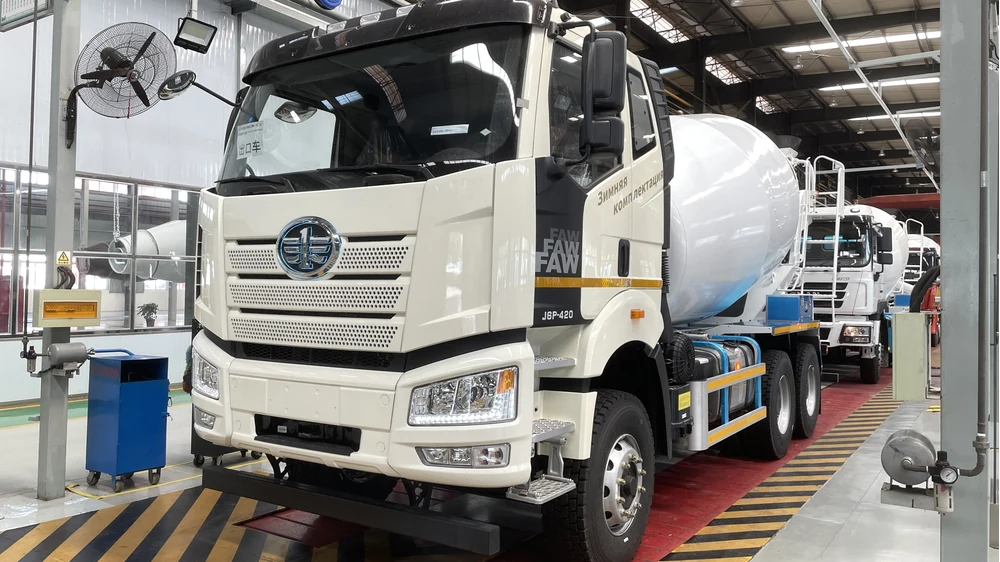
Concrete Mixer Truck
Compare CMT3, CMT4, CMT5, CMT6, CMT8, CMT9, CMT10 and CMT12, with source-listed maximum mixing volumes of 3–12 m³ and separate geometric tank capacities.
- CMT3 / 4 / 5 / 6 and CMT8 / 9 / 10 / 12
- 3–12 m³ maximum mixing-volume entries
- Separate vehicle and mixing-tank dimensions
Model data is supplied by the client. Configuration and operating conditions need confirmation for your order.
Overview
A concrete mixer truck combines a road-vehicle chassis with a rotating mixing drum for concrete transport and discharge. The equipment must be selected around the concrete supply method, delivery route, receiving area and the limits of the configured vehicle.
The EPDAS schedule covers eight CMT models in two tables. Their listed maximum mixing volumes are 3, 4, 5, 6, 8, 9, 10 and 12 m³. Geometric tank-volume entries are larger and must not be advertised as the same thing.
Although the source heading refers to 8–12 m³, it also contains the CMT3–CMT6 table. Both groups are retained so the full documented range remains available for comparison.
Compare the Two Documented Vehicle Groups
CMT3–CMT6
CMT3, CMT4, CMT5 and CMT6 list 3–6 m³ maximum mixing volumes with left-hand-drive 4 × 2 chassis entries. Dimensions and engine-power figures vary between model columns.
CMT8–CMT12
CMT8, CMT9, CMT10 and CMT12 list 8–12 m³ maximum mixing volumes and left-hand-drive 6 × 4 chassis entries. A selection of chassis names in a table does not confirm that every listed make is available for every order.
EPDAS CMT Mixer Truck Specifications
The two complete original matrices retain geometric tank volume, maximum mixing volume, feeding/unloading entries and chassis details. Source-stated performance and engine labels require confirmation for the configured truck and operating conditions.
| Vehicle Model | CMT3 | CMT4 | CMT5 | CMT6 |
|---|---|---|---|---|
| Overall Size (mm) | 6300*2300*3300 (L*W*H) | 6460*2300*3450 (L*W*H) | 6460*2255*3300 (L*W*H) | 7398*2490*3650 (L*W*H) |
| Mixing Tank Size (mm) | 3380*φ1670 | 3520*φ1800 | 3520*φ1950 | 3860*φ2100 |
| Mixing Tank Volume | 5.05 m³ | 6.15 m³ | 7.25 m³ | 8.75 m³ |
| Max. Mixing Volume | 3 m³ | 4 m³ | 5 m³ | 6 m³ |
| Concrete Feeding Speed | ≥2 m3/min | ≥2 m3/min | ≥2 m3/min | ≥2 m3/min |
| Concrete Unloading Speed | ≥1.5 m3/min | ≥1.5 m3/min | ≥1.5 m3/min | ≥1.5 m3/min |
| Unloading Residue Rate | ≤0.8% | ≤0.8% | ≤0.8% | ≤0.8% |
| Hydraulic Pump | High-Tech, China Brand | High-Tech, China Brand | High-Tech, China Brand | High-Tech, China Brand |
| Hydraulic Motor | High-Tech, China Brand | High-Tech, China Brand | High-Tech, China Brand | High-Tech, China Brand |
| Reducer | High-Tech, China Brand | High-Tech, China Brand | High-Tech, China Brand | High-Tech, China Brand |
| Water Supply System | Pneumatic water supply (150L water tank), China-made sprinkler | Pneumatic water supply (150L water tank), China-made sprinkler | Pneumatic water supply (150L water tank), China-made sprinkler | Pneumatic water supply (150L water tank), China-made sprinkler |
| Heat Radiator | 12L, China Brand | 12L, China Brand | 12L, China Brand | 12L, China Brand |
| Mixer Truck Chassis (Left-hand driving, 4*2) | Mixer Truck Chassis (Left-hand driving, 4*2) | Mixer Truck Chassis (Left-hand driving, 4*2) | Mixer Truck Chassis (Left-hand driving, 4*2) | Mixer Truck Chassis (Left-hand driving, 4*2) |
| Manufacturer brand | AUMAN/ DFAC/ T·KING | AUMAN/ DFAC/ T·KING | AUMAN/ DFAC/ T·KING | AUMAN/ DFAC/ T·KING |
| Wheel Base (mm) | 3100 | 3400 | 3400 | 3900 |
| Tread F/R (mm) | 1650/1610 | 1790/1725 | 1774/1669 | 1940/1870 |
| Max. Speed (km/h) | 85 | 80 | 85 | 80 |
| Steering System | Recirculating ball steering,Front-wheel steering | Recirculating ball steering,Front-wheel steering | Recirculating ball steering,Front-wheel steering | Recirculating ball steering,Front-wheel steering |
| Transmission | Manual transmission | Manual transmission | Manual transmission | Manual transmission |
| Brake System | Air-pressure braking | Air-pressure braking | Air-pressure braking | Air-pressure braking |
| Chassis Engine | Euro-IV, L4, 4-Strokes supper charged medium cold diesel engine | Euro-IV, L4, 4-Strokes supper charged medium cold diesel engine | Euro-IV, L4, 4-Strokes supper charged medium cold diesel engine | Euro-IV, L4, 4-Strokes supper charged medium cold diesel engine |
| Engine Power (hp) | 116 | 116 | 130 | 180 |
| Fuel Type | Diesel oil | Diesel oil | Diesel oil | Diesel oil |
| Vehicle Model | CMT8 | CMT9 | CMT10 | CMT12 |
|---|---|---|---|---|
| Overall Size (mm) | 9020*2495*3850 (L*W*H) | 9020*2495*3850 (L*W*H) | 9580*2500*3920 (L*W*H) | 9870*2500*3990 (L*W*H) |
| Mixing Tank Size (mm) | 4720*φ2300 | 4990*φ2300 | 5370*φ2300 | 5790*φ2300 |
| Mixing Tank Volume | 13.3 m³ | 14.7 m³ | 15.8 m³ | 19.6 m³ |
| Max. Mixing Volume | 8 m³ | 9 m³ | 10 m³ | 12 m³ |
| Concrete Feeding Speed | ≥3.5 m3/min | ≥3.5 m3/min | ≥3.5 m3/min | ≥3.5 m3/min |
| Concrete Unloading Speed | ≥2.5 m3/min | ≥2.5 m3/min | ≥2.5 m3/min | ≥2.5 m3/min |
| Unloading Residue Rate | ≤0.5% | ≤0.5% | ≤0.5% | ≤0.5% |
| Hydraulic Pump | PMH P90, Italy | PMH P90, Italy | ARK pump, Italy | ARK pump, Italy |
| Hydraulic Motor | PMH M90, Italy | PMH M90, Italy | ARK motor, Italy | ARK motor, Italy |
| Reducer | PMB6.5sp, Italy | PMB6.5sp, Italy | PMB7.1sp, Italy | PMB7.1sp, Italy |
| Water Supply System | Pneumatic water supply (450L water tank), China-made sprinkler | Pneumatic water supply (450L water tank), China-made sprinkler | Pneumatic water supply (450L water tank), China-made sprinkler | Pneumatic water supply (450L water tank), China-made sprinkler |
| Heat Radiator | 18L, China Brand | 18L, China Brand | 18L, China Brand | 18L, China Brand |
| Mixer Truck Chassis (Left-hand driving, 6*4) | Mixer Truck Chassis (Left-hand driving, 6*4) | Mixer Truck Chassis (Left-hand driving, 6*4) | Mixer Truck Chassis (Left-hand driving, 6*4) | Mixer Truck Chassis (Left-hand driving, 6*4) |
| Manufacturer brand | FOTON/SHACMAN/SINOTRUK/DONGFENG/FAW/JAC/HINO/MITSUBISHI/ISUZU | FOTON/SHACMAN/SINOTRUK/DONGFENG/FAW/JAC/HINO/MITSUBISHI/ISUZU | FOTON/SHACMAN/SINOTRUK/DONGFENG/FAW/JAC/HINO/MITSUBISHI/ISUZU | FOTON/SHACMAN/SINOTRUK/DONGFENG/FAW/JAC/HINO/MITSUBISHI/ISUZU |
| Wheel Base (mm) | 3575+1350 | 3575+1350 | 3825+1350 | 4025+1350 |
| Tread F/R (mm) | 2010/1860 | 2010/1860 | 2022/1830 | 2022/1830 |
| Max. Speed (km/h) | 80 | 80 | 78 | 78 |
| Steering System | Imported ZF8098 hydraulic steering,Front-wheel steering | Imported ZF8098 hydraulic steering,Front-wheel steering | Imported ZF8098 hydraulic steering,Front-wheel steering | Imported ZF8098 hydraulic steering,Front-wheel steering |
| Transmission | Manual transmission | Manual transmission | Manual transmission | Manual transmission |
| Brake System | Dual-circuit Air-pressure braking | Dual-circuit Air-pressure braking | Dual-circuit Air-pressure braking | Dual-circuit Air-pressure braking |
| Chassis Engine | Euro-VI, L6, Water-cooling, 4-Strokes supper charged medium cold diesel engine | Euro-VI, L6, Water-cooling, 4-Strokes supper charged medium cold diesel engine | Euro-VI, L6, Water-cooling, 4-Strokes supper charged medium cold diesel engine | Euro-VI, L6, Water-cooling, 4-Strokes supper charged medium cold diesel engine |
| Engine Power (hp) | 350 | 350 | 336 | 336 |
| Fuel Type | Diesel oil | Diesel oil | Diesel oil | Diesel oil |
Maximum mixing volume is distinct from geometric tank volume and permitted road payload. Source performance, chassis, emission and component entries require confirmation for the actual configured vehicle and destination.
Vehicle, Drum and Hydraulic Drive
Mixing Drum
The tank-volume row describes geometric space in the drum. The maximum mixing-volume row is a separate concrete-capacity entry. For example, CMT12 lists a 19.6 m³ tank and 12 m³ maximum mixing volume; these values must remain distinct.
Hydraulic Mixing Drive
Pump, motor and reducer entries identify the drum-drive package by group and model. Confirm the actual components, documentation and support scope rather than assuming that all trucks share one package.
Road-Vehicle Chassis
Chassis, wheelbase, brakes, steering and engine entries affect vehicle fit. The assembled truck needs to be evaluated as a complete configuration rather than treating the drum as its legal payload rating.
How Transport and Drum Operation Work Together
Concrete or its specified ingredients enter the drum through the receiving arrangement. Drum operation maintains the required mixing or agitation function for the agreed supply method, followed by discharge at the receiving point.
The actual production method matters. A truck receiving already-mixed concrete and a truck completing a specified mixing process are different operating arrangements; the source does not provide a verified procedure for every method.
Loading, drum speed, travel and discharge must follow the actual equipment instructions and the concrete producer’s requirements. This page is not an operating or concrete acceptance procedure.
Separate Mixing Volume from Permitted Payload
A 12 m³ maximum mixing-volume entry is not proof that 12 m³ of any concrete may legally be carried on every road. Concrete density, vehicle mass, axle loads and destination requirements must be checked for the actual truck.
The table does not provide a complete axle-load or legal-payload approval. Confirm the chassis and finished vehicle documentation before using a mixing-volume figure in transport planning.
Coordinate Batching, Journey and Discharge
The delivery operation needs an agreed concrete specification, loading records and receiving arrangements. Travel delays and a restricted unloading area can affect the supply schedule even when the drum has sufficient nominal capacity.
Water-tank capacity does not establish permission to add that quantity to the concrete. Any water adjustment must remain within the producer’s approved mix and quality process, with the required record and acceptance checks.
Match the Truck to the Delivery Operation
Concrete Delivery Fleets
Mixer trucks can be assessed for concrete delivery between a production point and a construction site. Compare batch sizes, access, queueing space and the required arrival pattern together.
Supplying a Concrete Pump
If concrete is discharged into a pump, coordinate the receiving geometry and the supply rate with that pump. A truck’s feeding or unloading entry cannot alone establish the completed placement rate.
Check the Route and Receiving Clearance
Review the full vehicle length, width, height and wheelbase for the selected model. The larger CMT group has different dimensions and axle arrangements from the smaller group, so a route suitable for one cannot automatically be used for another.
Confirm access beneath overhead restrictions, turning approaches and the discharge position. Tank dimensions alone cannot establish vehicle clearance or the space needed to serve a hopper or receiving chute.
Water Storage and Vehicle Documentation
The smaller group lists a 150 L water tank and the larger group 450 L. These are system-storage entries and should be matched to the actual cleaning and supply arrangement, not treated as batch-water prescriptions.
The source describes Euro-IV engines in the smaller group and Euro-VI in the larger group. These labels require verification for the actual engine and destination; they do not establish registration or approval for every market.
Plan Drum and Chassis Maintenance
The vehicle and mixing body have related but distinct servicing requirements. The drum drive, hydraulics, water system and wear components need their applicable maintenance instructions in addition to chassis servicing.
Discuss manuals, inspection records, commissioning, spare parts and support arrangements with EPDAS. Confirm responsibility for both the selected chassis and body; warranty and service response are not fixed by the general table.
Compare the Delivered Concrete Route
A useful comparison includes the configured vehicle, legal carrying capability, delivery cycle, servicing and the receiving operation. A larger drum may not improve productivity where site access or unloading space is the limiting factor.
The source’s feeding, unloading and residue figures are stated under unspecified conditions. Obtain the relevant performance basis before calculating fleet size, a fixed cost per delivery or a promised cycle time.
Frequently Asked Questions
Which models are documented?
CMT3, CMT4, CMT5, CMT6, CMT8, CMT9, CMT10 and CMT12 appear in the two supplied tables.
What maximum mixing volumes are listed?
The model entries are 3, 4, 5, 6, 8, 9, 10 and 12 m³ respectively.
Is tank volume the concrete mixing capacity?
No. The geometric tank-volume row is separate from maximum mixing volume. Both are preserved in the tables.
Does the 8–12 m³ heading exclude smaller models?
No. The source also includes CMT3–CMT6. Both complete model groups remain on the page.
What chassis arrangements are listed?
The smaller group lists left-hand-drive 4 × 2 chassis; the larger group lists left-hand-drive 6 × 4 chassis. Confirm the actual order.
Does maximum mixing volume establish legal payload?
No. Vehicle mass, axle loading, concrete density and destination requirements need separate verification.
Are all chassis names confirmed as available?
No. They are source-listed selections. Confirm the exact make and completed vehicle configuration for the order.
What water-tank capacities are shown?
The smaller group lists 150 L and the larger group 450 L. These are storage capacities, not approved water additions to a batch.
Are feeding and unloading rates guaranteed for every mix?
No. They are source-stated entries without a complete performance basis. Confirm conditions for the intended concrete and operation.
Does the vehicle include self-loading equipment?
The CMT schedules do not establish self-loading functionality. The separate self-loading mixer pages describe different equipment.
Manufacturing & product evidence
EPDAS identifies specialized manufacturing bases for the relevant equipment families.
Pending confirmation. Model-specific inspection and certification evidence remains to be confirmed.
Compare an EPDAS Mixer Truck for Your Delivery Route
Discuss the documented configuration with EPDAS and review how it fits your concrete supply and placement plan. Final equipment, documentation and support scope are confirmed for the order.
Discuss CMT Configurations