
Concrete Mixers
Self-Loading Concrete Mixer
Compare EP H-series and QC-series self-loading concrete mixers, with documented output capacities of 2.5–5.5 m³ per batch and distinct chassis, transmission and water-storage arrangements.
- 2.5–5.5 m³ output per batch across documented models
- H-series and QC-series configurations
- Model-specific engine and chassis data
Model data is supplied by the client. Configuration and operating conditions need confirmation for your order.
Overview
A self-loading concrete mixer combines material loading and drum mixing on a mobile machine. It can be assessed where concrete preparation needs to stay close to the work and the project can organize suitable materials, water and controlled batching.
The EPDAS range here includes EP2.5H, EP4.0H and EP5.5H, plus EP2.6QC, EP3.5QC and EP4.0QC. Their source-listed outputs are per batch, not per hour. Loading, proportioning, mixing, travel and discharge all contribute to the actual work cycle.
Self-loading describes a handling function. It does not establish automatic ingredient weighing, automatic moisture correction or a complete quality-control system.
Compare H-Series and QC-Series Arrangements
EP H-Series
The H-series lists 2.5, 4.0 and 5.5 m³ output per batch, an integral off-road frame and full hydraulic transmission. The source also specifies 4 × 4 drive entries. Review the selected machine’s operating limits rather than reading “off-road” as approval for every surface.
EP QC-Series
The QC-series lists 2.6, 3.5 and 4.0 m³ per batch, articulated steering and mechanical transmission. Its drive-type descriptions differ between columns and should be clarified for the actual order, rather than normalized by assumption.
EPDAS Self-Loading Mixer Specifications
Both original model matrices are retained. H-series overall-size entries include alternative heights in brackets; their operating meanings need confirmation from drawings. The QC rotation entry of 0°/270° on EP2.6QC also requires variant clarification.
| Model | Model | EP2.5H | EP4.0H | EP5.5H |
|---|---|---|---|---|
| Mixing System | Output capacity | 2.5m³ per batch | 4.0 m³ per batch | 5.5 m³ per batch |
| Mixing System | Rotation angle | 270° | 270° | 270° |
| Mixing System | Mixer Drum Angle | 16 ° | 16 ° | 16 ° |
| Mixing System | Loader control | Hydraulic 4 way stick | Hydraulic 4 way stick | Hydraulic 4 way stick |
| Mixing System | Swing Reducer | Customized by EPDAS | Customized by EPDAS | Customized by EPDAS |
| Mixing System | Water Tank Volume | 370 L | 550 L | 620 L |
| Engine | Brand | YUNNEI | YUNNEI | YUCHAI |
| Engine | Rated Power/RPM | 76KW/2200RPM | 92KW/2200RPM | 110KW/2200RPM |
| Chassis | Total Weight | 6600 KG | 8500 KG | 9200 KG |
| Chassis | Driver Type | 4*4 | 4*4 | 4*4 |
| Chassis | Chassis | Off-road-Integral frame | Off-road-Integral frame | Off-road-Integral frame |
| Chassis | Wheel Base | 1960 mm | 2350 mm | 2420 mm |
| Chassis | Tyre | 23.5-16 | 16/70-20 | 16/70-24 |
| Chassis | Transmission | Full Hydraulic | Full Hydraulic | Full Hydraulic |
| Chassis | Speed | High:20-40 KM/H | High:20-40 KM/H | High:20-40 KM/H |
| Chassis | Speed | Low:0-20 KM/H | Low:0-20 KM/H | Low:0-20 KM/H |
| Chassis | Grade-ability | 30° | 30° | 30° |
| Chassis | Overall Size | L7040*W2530*H3200mm (H4200mm) | L7600*W2800*H3380mm (H4760mm) | L7820*W2850*H3400mm (H4780mm) |
| Model | Model | EP2.6QC | EP3.5QC | EP4.0QC |
|---|---|---|---|---|
| Mixing System | Output capacity | 2.6m³ per batch | 3.5 m³ per batch | 4.0 m³ per batch |
| Mixing System | Rotation angle | 0°/270° | 270° | 270° |
| Mixing System | Mixer Drum Angle | 16 ° | 16 ° | 16 ° |
| Mixing System | Loader control | Hydraulic 4 way stick | Hydraulic 4 way stick | Hydraulic 4 way stick |
| Mixing System | Swing Reducer | Customized by EPDAS | Customized by EPDAS | Customized by EPDAS |
| Mixing System | Water Tank Volume | 1 x 750 L water tank | 1 x 880 L water tank | 1 x 750 Lwater tank |
| Engine | Brand | YUCHAI | YUCHAI | YUCHAI |
| Engine | Rated Power/RPM | 78KW/2200RPM | 85KW/2400RPM | 91KW/2600RPM |
| Chassis | Total Weight | 7000 KG | 8250 KG | 9000 KG |
| Chassis | Driver Type | Front 2 + Back 2 | Front 4 + Back 2 | Front 2 + Back 2 |
| Chassis | Steering | Hyduaulic articulated steering | Hyduaulic articulated steering | Hyduaulic articulated steering |
| Chassis | Wheel Base | 2770 mm | 2750 mm | 2950 mm |
| Chassis | Tyre | 1670/20-16 | 12R-22.5 | 12R-22.5 |
| Chassis | Speed | Low:0-25 KM/H High:0-35 KM/H | Low:0-20 KM/H High:20-35 KM/H | Low:0-20 KM/H High:2-40 KM/H |
| Chassis | Transmission | Mechanical | Mechanical | Mechanical |
| Chassis | Grade-ability | 30° | 40° | 40° |
| Chassis | Overall Size | L6650*W2700*H3200mm | L7300*W2750*H2892mm | L7700*W2950*H3400mm |
Output is listed per batch, not per hour. Source dimensions, drive descriptions, rotation variants and operating conditions require confirmation for the selected machine; no automated weighing package or road approval is implied.
Loading, Mixing and Water Systems
Material Loader
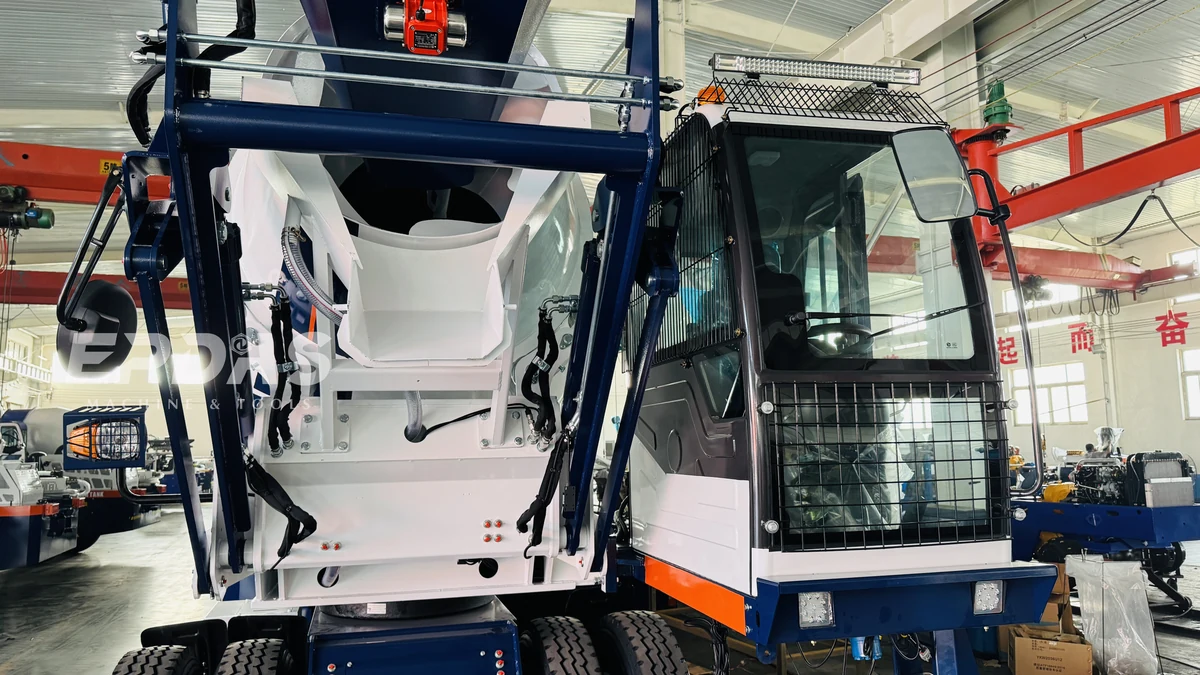
All six models list hydraulic four-way loader control. The loading arrangement brings material to the machine; the amount loaded still needs to follow the project’s approved concrete recipe and measurement process.
Mixing Drum and Positioning
The schedule lists mixing-system rotation and drum-angle entries. These describe mechanical geometry, not a guarantee of mixing time, uniformity or unrestricted discharge access.
Water Storage
Water-tank volumes differ between the groups and models. Tank storage provides available water on the machine; it is not a required water dose for a batch or evidence that every batch uses the whole tank.
How Mobile Batch Preparation Works
Materials are brought to the loading position, measured for the selected mix and transferred into the mixing system. Water must also be controlled against the mix requirements. The drum combines the ingredients before concrete is delivered to its discharge point.
The machine’s mobility can connect material loading and site placement, but the route and the time needed to complete each operation remain part of production planning. Batch capacity alone does not determine how many batches can be completed in an hour.
This is a general explanation. Loading limits, movement, drum operation and discharge procedures require the applicable manual and trained operators.
Keep Batch Output Separate from Travel Ratings
The largest documented batch output is 5.5 m³ on EP5.5H. It does not establish an hourly rate without a verified cycle and supply arrangement. Compare batch size with the actual demand and placement resources.
The source includes speed and gradeability entries. These are not permission to travel at a listed maximum while loaded or on a particular slope, and they do not establish road registration. Confirm the conditions attached to the selected vehicle.
Control Ingredients Rather Than Counting Buckets
Concrete quality depends on controlled proportions and suitable materials. Loader movements or a stated drum capacity cannot establish the correct masses of aggregate, cement and water. Confirm how the project will measure each ingredient.
The supplied tables do not document an automatic weighing or moisture-compensation package. If those functions are required, specify them separately and obtain the applicable technical confirmation before relying on them.
Assess Concrete Preparation Near the Work
Distributed Site Work
A mobile loading-and-mixing arrangement may be assessed for construction locations where suitable raw materials and water can be organized close to the placing operation. The choice must account for both the production cycle and the travel route.
Choosing the Supply Method
Compare self-loading preparation with delivered ready-mixed concrete or a fixed production point. Relevant factors include demand consistency, material handling, testing arrangements and access—not simply the number of functions on one vehicle.
Plan the Loading and Discharge Locations
Check material stockpiles, replenishment access, the travel route and the receiving point. Loading and discharge both need sufficient clearance, and the machine’s relevant operating height may differ from its transport profile.
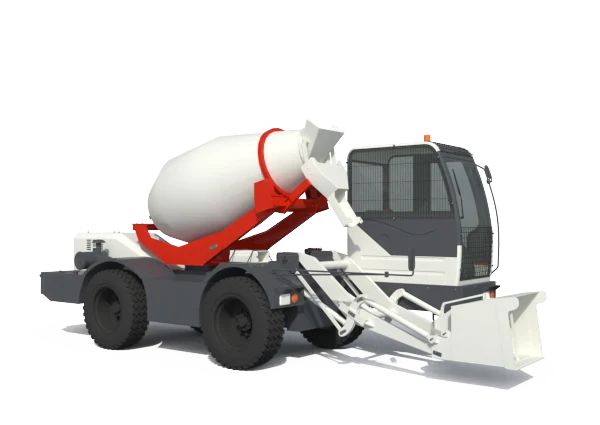
Review the exact frame, steering and transmission configuration with the selected model’s dimensions. An illustrated machine does not establish that all versions fit the same gate or use the same turning space.
Water Supply, Terrain and Washout
Plan replenishment and water quality alongside tank capacity. Cleaning water and controlled batch water serve different purposes, even when resources are organized in the same work area.
Provide appropriate washout and residual-concrete management, and assess surfaces and weather against the equipment instructions. Engine power, drive type and tyres do not by themselves establish unrestricted access or emission approval.
Maintain the Loader, Drum and Driveline
The loading equipment, drum system, hydraulics and chassis need their prescribed inspections and servicing. Hydraulic and mechanical transmission groups may have different maintenance requirements; use the documentation for the delivered configuration.
Discuss manuals, commissioning, training, spare parts and support with EPDAS. The product data does not fix service intervals, warranty length, delivery time or a measured maintenance-cost saving.
Compare the Complete Concrete Preparation Cycle
Include the machine, loading resources, water replenishment, material measurement, testing and cleaning arrangements in the comparison. Combining equipment functions does not eliminate these supporting requirements.
Consider batch size, journey time and placement capacity over the intended work pattern. A realistic ownership comparison uses the complete cycle rather than multiplying the largest batch volume by an assumed cycle count.
Frequently Asked Questions
Which self-loading mixer models are shown?
EP2.5H, EP4.0H, EP5.5H, EP2.6QC, EP3.5QC and EP4.0QC are documented.
What output range is listed?
The model tables span 2.5–5.5 m³ per batch. The figures are not hourly production ratings.
How do the H and QC groups differ?
The H-series lists integral off-road frames and full hydraulic transmission. The QC-series lists articulated steering and mechanical transmission.
Is automatic weighing established?
No. The supplied tables do not document an automatic ingredient-weighing package. Confirm any required system separately.
Does water-tank volume equal batch water?
No. It is storage capacity. The required water dose follows the approved mix and material condition.
Can hourly output be calculated from batch size alone?
No. Loading, measurement, mixing, travel and discharge time must also be established.
Are all rotation entries identical?
No. EP2.6QC is listed as 0°/270°; the applicable variant needs clarification. Other shown entries list 270°.
What do the alternative H-series heights mean?
The source includes bracketed heights without a complete operating explanation. Confirm them against the selected machine’s drawings.
Does gradeability prove suitability for a loaded route?
No. The actual conditions and permitted operating limits need confirmation from the model documentation and site assessment.
Is this the same as a concrete transit mixer truck?
No. These machines include self-loading functionality. The CMT truck page covers a separate transport/mixing vehicle range.
Manufacturing & product evidence
EPDAS identifies specialized manufacturing bases for the relevant equipment families.
Pending confirmation. Model-specific inspection and certification evidence remains to be confirmed.
Compare an EPDAS Self-Loading Mixer for Your Site Cycle
Discuss the documented configuration with EPDAS and review how it fits your concrete supply and placement plan. Final equipment, documentation and support scope are confirmed for the order.
Discuss Self-Loading Mixer Configurations