

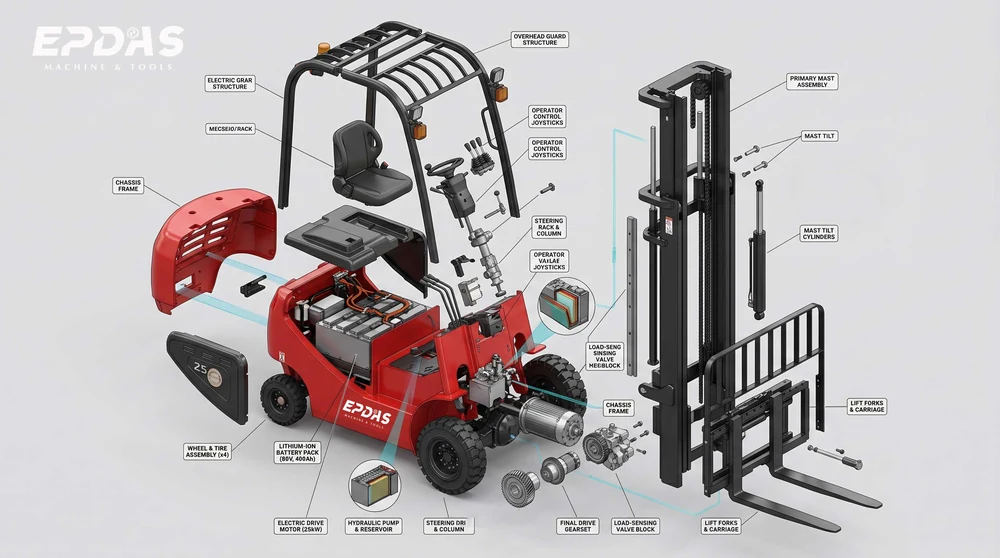
Telescopic Handler Forklifts
Electric Forklift
Compare six seated EPDAS CPD electric forklifts with 1,000–5,000 kg rated capacities, a listed 500 mm load centre and lead-acid battery configurations.
- CPD10 / 20 / 35 / 40 / 45 / 50
- 1,000–5,000 kg rated capacity across models
- Seated driving configuration
Model data is supplied by the client. Configuration and operating conditions need confirmation for your order.
Overview
An electric forklift uses battery power for material movement and hydraulic lifting. For a warehouse or production facility, the selection needs to connect pallet loads and rack access with the available operating space and charging arrangement.
The EPDAS electric forklift table covers CPD10, CPD20, CPD35, CPD40, CPD45 and CPD50. Rated capacities run from 1,000 to 5,000 kg, with a listed 500 mm load centre and 3,000 mm maximum lift height across these configurations.
These are seated, mast-type forklifts within the handling-equipment category. They are not telescopic-boom machines, and their capacity, access and energy requirements should be evaluated on their own terms.
Choose Capacity Together with Site Access
Six Rated-Capacity Choices
CPD10 and CPD20 list 1,000 and 2,000 kg rated capacities. CPD35, CPD40, CPD45 and CPD50 list 3,500, 4,000, 4,500 and 5,000 kg. Start with the load and its geometry, then check the selected configuration rather than choosing by pallet weight alone.
Capacity and Manoeuvring Space
Body widths, wheelbases and turning radii differ across the range. A larger truck may provide a higher nominal capacity while needing more operating space. Compare these dimensions with rack approaches, crossings and the room available to position a load.
EPDAS CPD Electric Forklift Specifications
The original technical matrix retains battery, motor, tyre, mast and dimensional entries. Blank or slash entries remain as supplied and should not be treated as confirmed zero values. Ambiguous mast-extension labels require clarification for the selected truck.
| Model | Unit | CPD10 | CPD20 | CPD35 | CPD40 | CPD45 | CPD50 | |
|---|---|---|---|---|---|---|---|---|
| Driving mode | Seated | Seated | Seated | Seated | Seated | Seated | ||
| Rated capacity | Q | kg | 1000 | 2000 | 3500 | 4000 | 4500 | 5000 |
| Load center distance | C | mm | 500 | 500 | 500 | 500 | 500 | 500 |
| Power mode | Lead-acid Battery | Lead-acid Battery | Lead-acid Battery | Lead-acid Battery | Lead-acid Battery | Lead-acid Battery | ||
| Wheelbase | L1 | mm | 1330 | 1550 | 1850 | 2040 | 2040 | 2040 |
| Tyre | Tyre | Tyre | Tyre | Tyre | Tyre | Tyre | Tyre | Tyre |
| Tyre type | Solid Tires | Solid Tires | Pneumatic Tire | Solid Tires | Solid Tires | Solid Tires | ||
| Wheels number(front/rear) | 2/2 | 2/2 | 2/2 | 2/2 | 2/2 | 2/2 | ||
| Front track | W3 | mm | 910 | 945 | 1002 | 1310 | 1310 | 1310 |
| Rear track | W2 | mm | 865 | 880 | 994 | 1110 | 1110 | 1110 |
| Tyre(front) | 15X4 1/2-8 | 18x7-10 | 28x9-15 | 250-15 | 250-15 | 250-15 | ||
| Tyre(rear) | 15X4 1/2-8 | 15X4 1/2-8 | 18x7-8 | 21X8-9 | 21X8-9 | 21X8-9 | ||
| Size | Size | Size | Size | Size | Size | Size | Size | Size |
| Front overhang | L2 | mm | 308 | 325 | 467 | 573 | 573 | 573 |
| Tilt of the mast,front/rear | α/β | ° | 5/10 | 5/10 | 5/10 | 6/12 | 6/12 | 6/12 |
| Height,mast retraction | H1 | mm | 2017 | 2030 | 2057 | 2340 | 2340 | 2340 |
| Free lift height | H3 | mm | / | / | 120 | 120 | 120 | 120 |
| Overall maximum lift height | H | mm | 3000 | 3000 | 3000 | 3000 | 3000 | 3000 |
| Height,mast extended | H2 | mm | 3957 | 4055 | 4200 | 4220(fork excluded)3790 | 4220(fork excluded)3790 | 4220(fork excluded) 3790 |
| Overhead guard height | H4 | mm | 1847 | 2110 | 2200 | 2350 | 2350 | 2350 |
| Lateral Fork Adjustment(Outside of Forks) Max/Min | W5 | mm | 970/200 | 1040/100 | 1100/244 | 1240/300 | 1240/300 | 1240/300 |
| Fork size (LxWxT) | T*W*L4 | mm | 30*100*1070 | 40*100*1070 | 45*122*1070 | 50*145*1070 | 50*150*1070 | 55*150*1070 |
| Truck body length(fork excluded) | L' | mm | 1980 | 2230 | 2600 | 2990 | 2990 | 2990 |
| Truck body width | W1 | mm | 1020 | 1096 | 1225 | 1585 | 1585 | 1585 |
| Turning radius | R | mm | 2050 | 2280 | 2300 | 2700 | 2700 | 2700 |
| Groubd clearance under mast | H5 | mm | 77 | 88 | 82 | 160 | 160 | 160 |
| Ground clearance at center of wheelbase(laden) | H6 | mm | 100 | 110 | 145 | 160 | 160 | 160 |
| Width of aisle right-angle stacking(pallet1000x1000mm clearance 200mm) | Ast | mm | 3400 | 3750 | 4300 | 4543 | 4543 | 4543 |
| Width of aisle right-angle stacking(pallet1200x1200mm clearance 200mm) | Ast | mm | 3650 | 3950 | 4500 | 4673 | 4673 | 4673 |
| Performance | Performance | Performance | Performance | Performance | Performance | Performance | Performance | Performance |
| Travel speed,laden/unladen | km/h | 10/11 | 7.5/8.5 | 10/10 | 12/13 | 12/13 | 12/13 | |
| Lifting speed,laden/unladen | mm/s | 220/230 | 180/200 | 200/300 | 280/300 | 270/280 | 250/280 | |
| Lowering speed,laden/unladen | mm/s | 550 | 550 | 450 | 450 | 450 | 450 | |
| Maximum negoniable gradient,laden/unladen | % | 15/20 | 15/20 | 12/20 | 15/20 | 15/20 | 12/20 | |
| Weight | Weight | Weight | Weight | Weight | Weight | Weight | Weight | Weight |
| Service mass(with battery) | kg | 1570 | 2550 | 4400 | 6660 | 6850 | 7100 | |
| Axle load:unloaded,front/rear | kg | 3230/3430 | 3220/3630 | 3200/3900 | ||||
| Axle load:loaded,front/rear | kg | 9380/1270 | 10160/1190 | 10850/1250 | ||||
| Battery voltage /nominal capacity | V/Ah | 60V/120Ah | 60V/210Ah | 72V/260Ah | 80V/300Ah | 80V/400Ah | 80V/500Ah | |
| Battery weight | kg | 150 | 300 | 430 | 860 | 860 | 1100 | |
| Electrical configuration | Electrical configuration | Electrical configuration | Electrical configuration | Electrical configuration | Electrical configuration | Electrical configuration | Electrical configuration | Electrical configuration |
| Drive motor power-60 minutes | kW | 5(PMSM) | 5(PMSM) | 9(PMSM) | 18AC | 18AC | 18AC | |
| Lift motor power-15 minutes | kW | 4.5(PMSM) | 4.5(PMSM) | 9(PMSM) | 16.5AC | 25AC | 25AC | |
| Drive motor controlling mode | MOSFET/PMSM | MOSFET/AC | MOSFET/AC | MOSFET/AC | MOSFET/AC | MOSFET/AC | ||
| Lifting motor controlling mode | MOSFET/PMSM | MOSFET/AC | MOSFET/AC | MOSFET/AC | MOSFET/AC | MOSFET/AC | ||
| Service brake/parking brake | Hydraulic/Mechanial | Hydraulic/Mechanial | Hydraulic/Mechanial | Hydraulic/Mechanial | Hydraulic/Mechanial | Hydraulic/Mechanial |
Table entries retain the supplied model data. Rated load, lift height and other maxima are separate values; confirm permitted capacity for the actual load, attachment and operating configuration using the applicable documentation.
Battery, Drive and Lifting Systems
Lead-Acid Battery Package
Every listed configuration specifies lead-acid battery power. The voltage/capacity entries range from 60 V/120 Ah on CPD10 to 80 V/500 Ah on CPD50. The battery, charger and electrical supply need to be matched as a complete package.
Travel and Lifting Motors
The table separately identifies drive motor power over a 60-minute rating and lift motor power over a 15-minute rating. These different labels must remain attached to their values; they are not interchangeable continuous-output promises.
Mast and Fork Carriage
The mast and fork carriage determine lifting access. Fork dimensions, lateral adjustment and mast heights should be reviewed against the pallet and storage arrangement. Any extra attachment needs its own compatibility and capacity review.
How Battery-Powered Handling Works
Stored electrical energy powers the truck’s travel drive and the lifting system. The mast guides the carriage as the forks raise or lower the supported load. Handling demand therefore combines travel, lifting and waiting time rather than a single constant power draw.
The energy used during a shift depends on the work pattern and conditions. A route with repeated lifting and frequent starts differs from one with longer periods of waiting. Battery capacity alone cannot establish operating hours.
This description explains the general system. Charging settings, operating sequences and maintenance procedures must follow the instructions for the supplied truck, battery and charger.
Check the Load Centre and Actual Capacity
All six models list a 500 mm load-centre distance. Longer or unevenly distributed loads, and changes in attachments, can alter the handling configuration. Use the truck’s applicable capacity information for the actual task.
The listed 3,000 mm lift height does not establish every rack application or capacity at every mast position. Confirm the mast, attachment, load geometry and operating conditions before using a capacity figure for selection.
Plan Charging Around the Working Shift
Map the operating periods, breaks and available charging location before selecting the energy package. Do not turn a V/Ah entry into a guaranteed shift duration, and do not assume that a larger nominal battery means a specific charging time.
Battery weight is also part of the truck configuration. Confirm the approved battery specification and charger rather than substituting another pack based only on its voltage or dimensions. The source does not establish a lithium-battery option for this range.
Evaluate Warehouse and Factory Tasks
Warehousing and Dispatch
Pallet movement between receiving, storage and dispatch can suit evaluation of a mast forklift. Review pallet condition, load distribution, rack access and traffic flow as one handling system.
Production Support
Supplying components to production areas may involve short, repeated journeys and shared space. Check clearances and the work schedule, together with the charging arrangement and pedestrian routes. Special environments require an explicitly suitable equipment configuration.
Use Pallet-Specific Aisle and Height Data
The table gives separate right-angle stacking aisle entries for 1,000 × 1,000 mm and 1,200 × 1,200 mm pallets, with the stated 200 mm clearance assumption. A turning-radius figure on its own is not the required stacking aisle width.
Check door openings against the relevant mast and overhead-guard heights. Mast-retracted height differs from the height needed while lifting. Review dock plates, floors and access structures for the actual loaded truck rather than assuming a warehouse floor suits every model.
Charging Space and Tyre Selection
Provide a suitable charging area for the supplied lead-acid system, including ventilation and the precautions required by its documentation and the workplace assessment. Charging infrastructure is part of making the truck usable, not simply an accessory to consider later.
Most shown models list solid tyres, while CPD35 lists pneumatic tyres. Match the actual tyre specification to the surface and intended use. Neither electric power nor tyre type alone establishes weatherproofing, cold-store suitability or approval for hazardous areas.
Maintain the Truck and Energy Package
Inspection and maintenance need to cover the truck as well as its battery and charger. Follow the supplied schedules for the mast, forks, brakes, tyres, hydraulics and electrical equipment; this page does not prescribe maintenance intervals.
Discuss manuals, training, battery documentation, replacement parts and support scope with EPDAS. Charger inclusion, warranty conditions and commercial arrangements must be stated in the order.
Compare the Cost of a Working Electric Fleet
Consider the truck, battery and compatible charger together with any electrical work and charging space. The right comparison accounts for the work pattern and infrastructure instead of relying only on the vehicle purchase price.
Review energy use, battery care, planned downtime and replacement requirements over the intended ownership period. No fixed runtime, energy saving or cost advantage can be calculated from the table alone.
Frequently Asked Questions
Which electric forklift models are listed?
The table covers CPD10, CPD20, CPD35, CPD40, CPD45 and CPD50, all with seated driving configurations.
What is the rated-capacity range?
The listed capacities span 1,000–5,000 kg at a 500 mm load centre. Confirm permitted capacity for the actual mast, attachment and load.
Which battery type is documented?
The supplied table lists lead-acid batteries for all six models. It does not confirm lithium batteries as an available option.
What lifting height is shown?
All six configurations list a 3,000 mm maximum lift height. Check the selected mast and actual storage requirement separately.
How long will a battery last per charge?
The available data does not establish runtime. Travel, lifting demand, battery condition and the shift pattern need to be evaluated with the supplied energy package.
Can turning radius be used as stacking aisle width?
No. Use the pallet-specific right-angle stacking aisle data and verify the actual layout. Turning radius and stacking aisle width describe different conditions.
Are all models fitted with solid tyres?
No. CPD35 lists pneumatic tyres. The other five documented configurations list solid tyres.
Is the charger included?
Charger inclusion and its compatibility with the battery and site supply require confirmation in the order.
Can any replacement battery with matching voltage be used?
Do not assume compatibility. Battery weight, capacity, connections and the approved truck/charger specification also need confirmation.
Is this a telescopic handler?
No. These CPD configurations are electric mast forklifts. The category also contains a separate telehandler page for telescopic-boom equipment.
Manufacturing & product evidence
EPDAS identifies specialized manufacturing bases for the relevant equipment families.
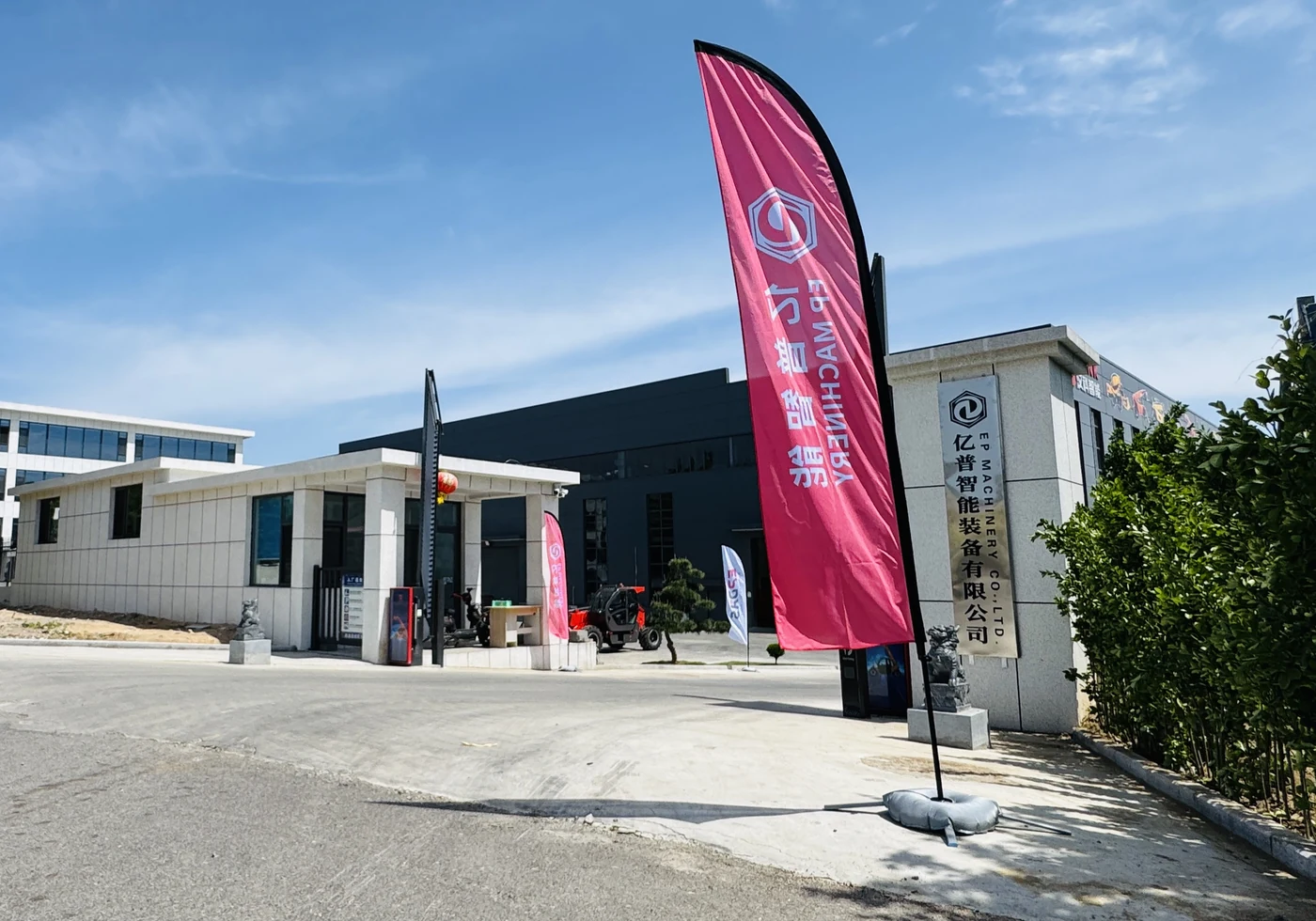
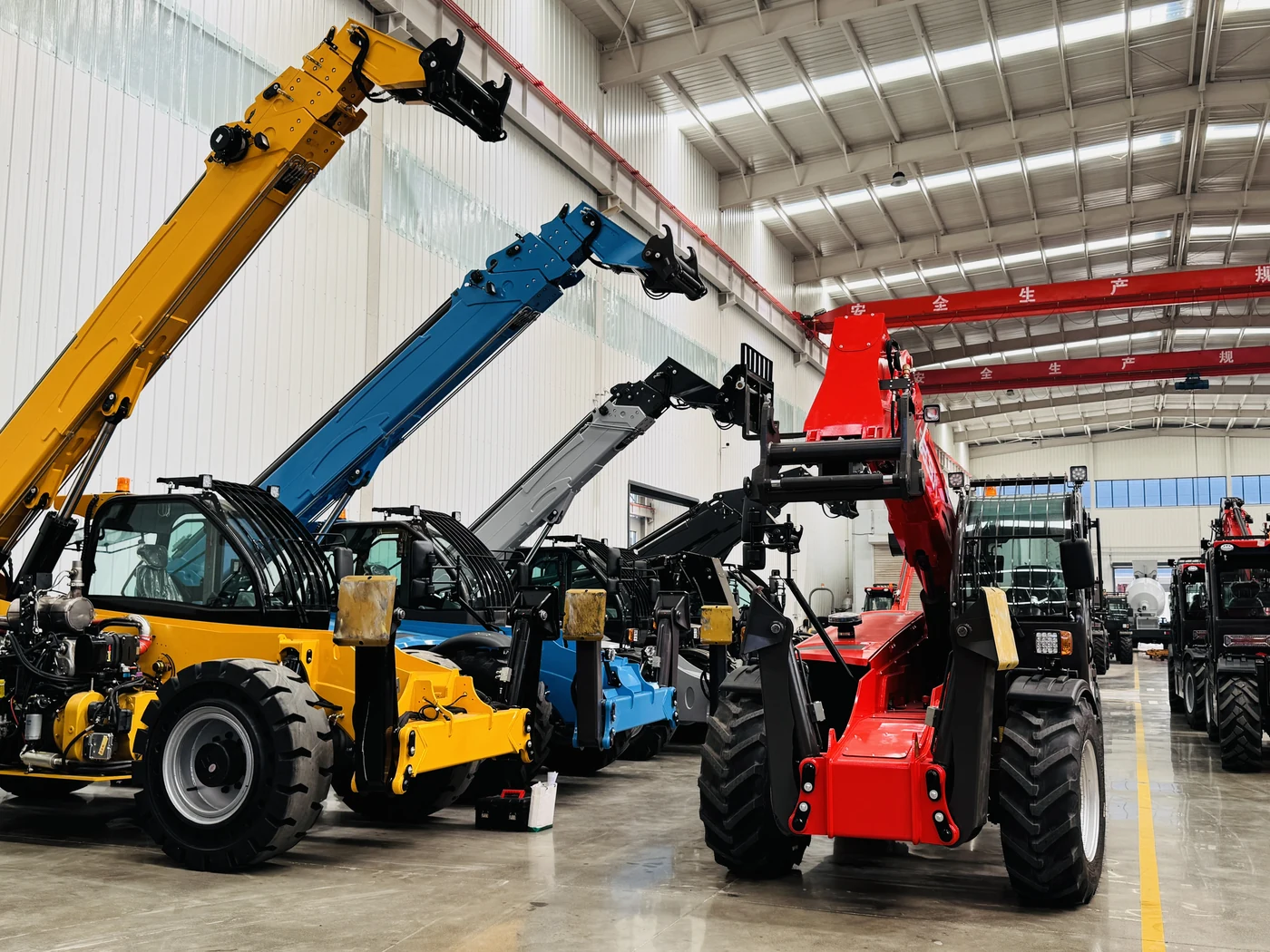
Pending confirmation. Model-specific inspection and certification evidence remains to be confirmed.
Plan an EPDAS Electric Forklift Around Your Handling Shift
Discuss the documented configurations with EPDAS and compare the equipment package against your handling operation. Model-specific documentation and the agreed supply scope remain part of the selection.
Discuss CPD Configurations